Ph.D. Student, Institute of Computing Technology, CAS
Hi, I'm Chen!
I am a Ph.D. student at the State Key Lab of Processors, ICT, CAS, advised by Prof. Weile Jia. My research focuses on AI for Science and High-Performance Computing, developing efficient learning methods and computing systems for atomistic simulation and materials design.
SO(3) equivariant graph neural networks have become the dominant paradigm for atomistic
foundation models, achieving high accuracy and data efficiency by building rotational symmetry
directly into the architecture. Yet the computational cost of their higher-order tensor
operations creates a tough trade-off between model accuracy and inference efficiency. In this
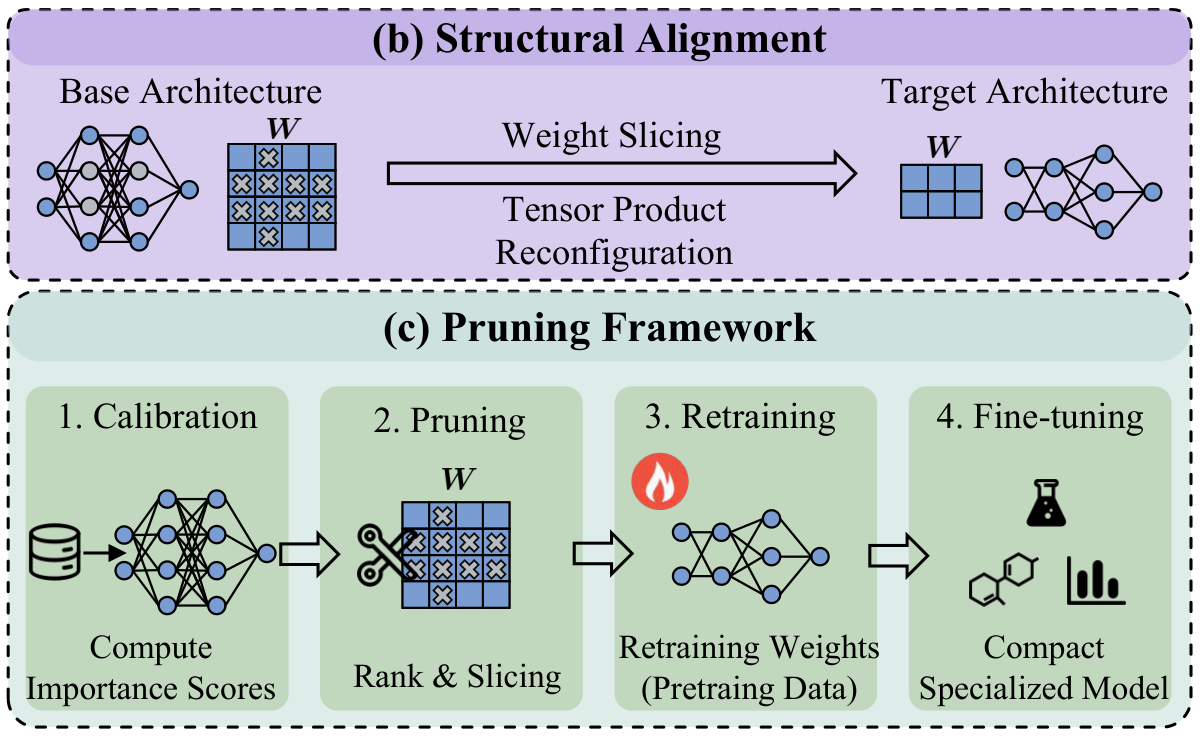
paper, we propose a structural pruning method for SO(3) equivariant atomistic foundation
models to bridge this accuracy-efficiency gap. The pruning is applied along the channel and
order dimensions, with each irreducible representation kept or removed as a complete block,
thereby retaining SO(3) equivariance. Starting from a large checkpoint, the pruned model
substantially reduces the inference cost while retaining higher accuracy than an independently
trained small model. The pruned MACE-MP model outperforms the official from-scratch trained
small model on 7 of 9 metrics on the Matbench Discovery leaderboard. In terms of efficiency,
compressed MACE-MP and MACE-OFF models contain 1.5× to 4× fewer parameters and require 2.5× to
4× less pre-training compute than training a small model from scratch. For downstream
applications, fine-tuning the pruned model reduces energy and force errors by 70.1% and 34.4%
compared to training task-specific models from scratch across eight representative downstream
datasets. We demonstrate that the method generalizes to other SO(3) equivariant architectures
(SevenNet, eSCN) and can be combined with quantization and knowledge distillation for further
gains.
Pre-trained interatomic potentials have become a new paradigm for atomistic materials
simulations, enabling accurate and efficient predictions across diverse chemical systems.
Despite their promise, fine-tuning is often required for complex tasks to achieve high
accuracy. Traditional parameter-efficient fine-tuning approaches are effective in NLP and CV.
However, when applied to SO(3) equivariant pre-trained interatomic potentials, these methods
will inevitably break equivariance—a critical property for preserving physical symmetries. In
this paper, we introduce ELoRA (Equivariant Low-Rank Adaptation), a novel fine-tuning method
designed specifically for SO(3) equivariant Graph Neural Networks (GNNs), the backbones in
multiple pre-trained interatomic potentials. ELoRA adopts a path-dependent decomposition for
weights updating which offers two key advantages: (1) it preserves SO(3) equivariance
throughout the fine-tuning process, ensuring physically consistent predictions, and (2) it
leverages low-rank adaptations to significantly improve data efficiency. We prove that ELoRA
maintains equivariance and demonstrate its effectiveness through comprehensive experiments. On
the rMD17 organic dataset, ELoRA achieves a 25.5% improvement in energy prediction accuracy
and a 23.7% improvement in force prediction accuracy compared to full-parameter fine-tuning.
Similarly, across 10 inorganic datasets, ELoRA achieves average improvements of 12.3% and
14.4% in energy and force predictions, respectively. Code will be made publicly available at
https://github.com/hyjwpk/ELoRA.
Architecture-agnostic knowledge distillation for machine-learning interatomic potentials
Atomistic foundation models can achieve near-ab-initio accuracy and strong transferability
across molecular and materials systems, but their large parameter counts lead to high
inference latency and memory cost, limiting long-time-scale molecular dynamics and
resource-constrained deployment. In many practical studies, only a narrow chemical subdomain
is required, motivating compact students that preserve the teacher’s physical priors. Existing
distillation for Machine-Learning Interatomic Potentials (MLIPs) is still limited by
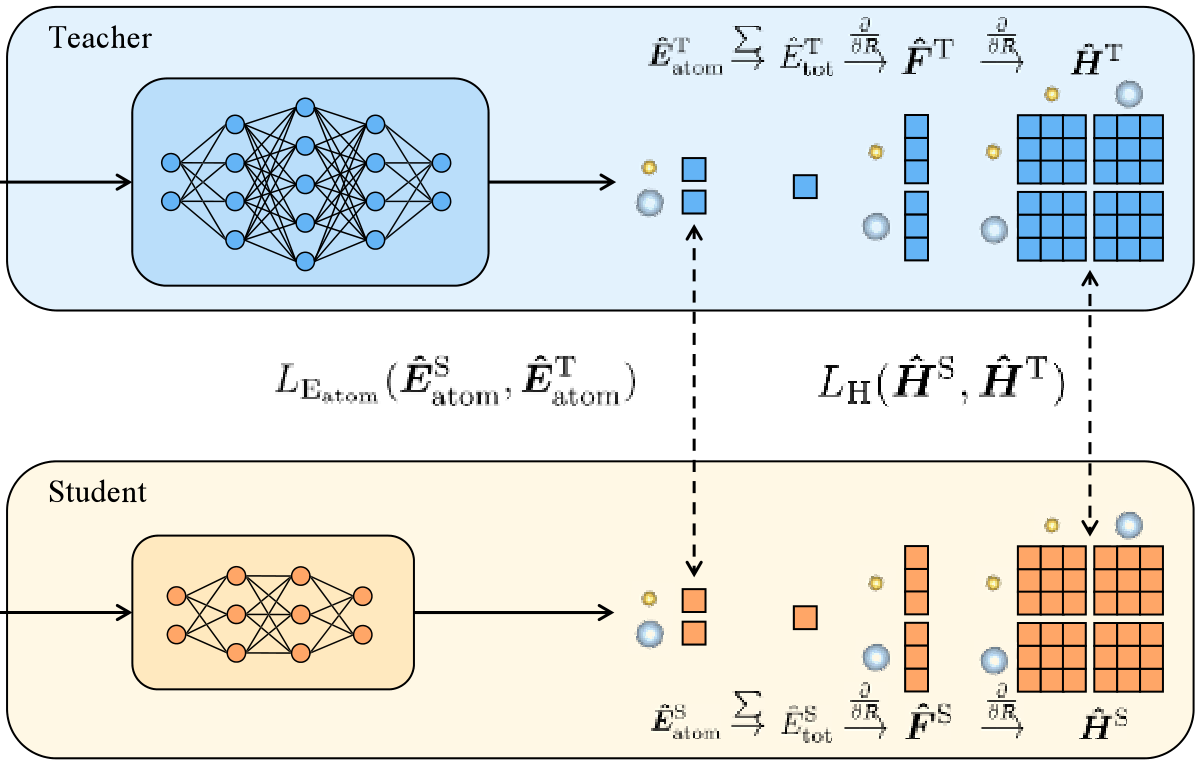
architecture mismatch or incomplete geometric supervision. We propose an architecture-agnostic
framework, Joint Atomic Energy–Energy Hessian Distillation, that requires no
architecture-specific feature projection. The method combines atomic-energy alignment, which
transfers local decomposition priors, with Hessian alignment, which transfers local curvature
of the potential energy surface. These two signals are complementary and jointly regularize
both decomposition consistency and geometric stability. Under matched training settings, our
method consistently improves energy accuracy over a strong Hessian-distillation baseline
(average gain: 48.3% on SPICE and 6.7% on MPtrj) while preserving force accuracy. Across
teacher–student pairs, it also reduces parameter counts by 79%–98%, enabling fast and
deployment-friendly specialized MLIPs for targeted chemical subdomains.
OMC-bench and AtomBit-OMC: task-aligned benchmarks and robust, interpretable machine-learned interatomic potentials for organic molecular crystals
Muyu Lu†, Chengxi Zhao†, Siyu Hu†, Danyang Chen†, Chen Wang†, Yixi Zhang, Yaolong Zhang, Man Luo, Fan Yu, Zhuoying Zhu, Bin Jiang, Guangming Tan, Weile Jia, Jun Jiang, Linjiang Chen
(† equal contribution)
Organic molecular crystals (OMCs) underpin key applications in pharmaceuticals and functional
materials, but accurate atomistic simulation remains difficult because OMC stability depends
on subtle noncovalent interactions, conformational flexibility, and polymorphism. Although
machine-learned interatomic potentials (MLIPs) have advanced rapidly for inorganic materials,
progress for OMCs has been constrained by (1) the lack of large, physically realistic training
data and (2) the lack of task-aligned benchmarks that probe deployment-relevant behaviour.
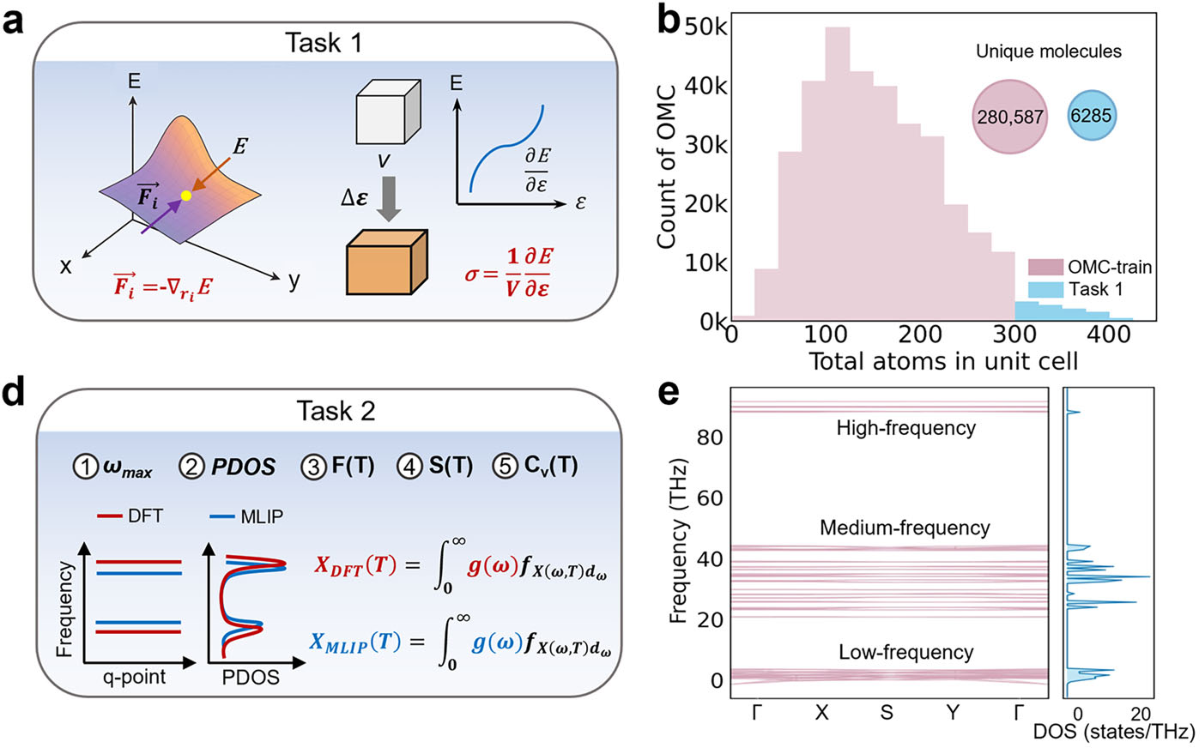
Here we introduce OMC-bench, a benchmark spanning four practical tasks—large-cell OOD
force/stress prediction, lattice dynamics, cocrystal relaxation, and polymorph energy
ranking—and an extensive OMC training dataset sampled from near-equilibrium to strongly
perturbed regimes. Benchmarking off-the-shelf MLIPs reveals a clear transfer gap, with
improved but still task-dependent performance at foundation scale. We train OMC-specialized
models and develop AtomBit-OMC, a new, efficient SE(3)-equivariant Cartesian-tensor model with
physics-informed gating and coupled scalar–equivariant updates. AtomBit-OMC variants achieve
strong cross-task performance on OMC-bench, including the lowest cocrystal structural-recovery
failure rate and the best polymorph-ranking metrics, while providing qualitative gate-weight
maps that highlight chemically relevant covalent and directional noncovalent contacts in
representative OMCs. Together, OMC-bench, the OMC training dataset, and AtomBit-OMC provide a
practical foundation for accelerating MLIP development in OMC modelling and discovery.
Constructing machine learning interatomic potentials with minimum amount of ab initio data
Machine learning interatomic potentials (MLIP) are powerful tools for using large-scale
molecular dynamics (MD) to evaluate material properties, including the performance of
solid-state electrolytes (SSEs). While there are many efforts for constructing universal big
MLIP models, their accuracies and speeds of inference still need to be improved for many
practical applications. Another approach is to develop a system-specific MLIP model relying on
active learning strategy. Although much cheaper than training a big model, using the
conventional procedure, it still requires large numbers of active learning loops and the
corresponding DFT calculations to ensure convergency. Here, we propose a single-shot workflow
that significantly accelerates small MLIP model development by leveraging the capabilities of
the big model (using MACE as one example) and requiring only a few hundred additional DFT
calculations. Our workflow comprises two stages, first the MACE model itself is fine-tuned to
make it more accurate for the given system, second a smaller MLIP model (using NEP as one
example) is distilled from the fine-tuned MACE model. We employed a MACE-driven sampling
strategy, carried out additional DFT calculations without relying on active learning
iterations. We show that fine-tuned MACE model can inherit the stability of the pretrained
model, and fine-tuning the pretrained MACE model is much more DFT data efficient comparing to
training a start-from-scratch NEP model. In the second stage, the fine-tuned MACE model
provides the dataset to train the NEP model, allows the final NEP model to carry out large
scale MD simulations with competitive accuracy. This integrated workflow establishes a
systematic pathway for rapid MLIP development via small additional DFT dataset, with potential
applications to many material systems.
A Two-Stage Equivariant Training Framework Enables Quantum-Accurate Force Fields with Reduced DFT Training Data
Si-Yu Hu, Jie Zhu, Chen Wang, Lin-Wang Wang, Hong-Liang Liu, Wei-Le Jia, Guang-Ming Tan
Journal of Computer Science and Technology 2026CCF B
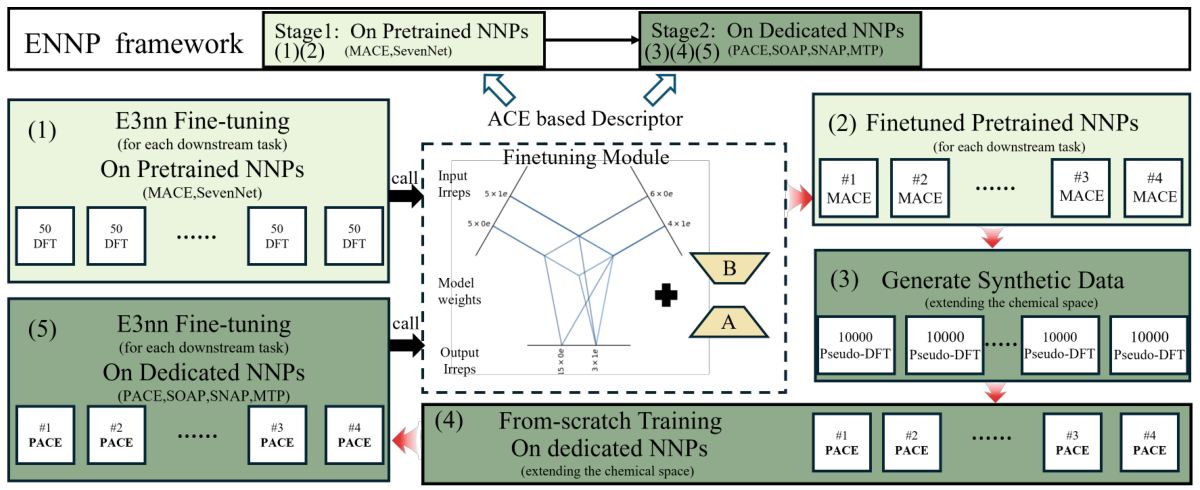
Neural network potentials (NNPs) have emerged as a powerful tool for materials simulations,
offering speedups of several orders of magnitude over molecular dynamics (MD) simulations
while retaining ab initio accuracy. This capability holds the promise of transforming the
paradigm of computational materials research. However, the development of NNPs is often
constrained by the high cost of accessing density functional theory (DFT) reference data. This
underscores a critical need for accurate and data-efficient NNPs that can be trained with only
limited DFT inputs. NNPs can be categorized into dedicated and pretrained models. Dedicated
NNPs deliver high accuracy for specific systems but suffer from data inefficiency, whereas
pretrained NNPs provide broad transferability at the expense of task-specific precision. Here,
we introduce a two-stage training framework that integrates the strengths of these two NNPs.
In the first stage (finetuning), we leverage a degree-parity-independent low-rank adaptation
(LoRA) finetuning strategy to enhance the accuracy of pretrained NNPs. In the second stage
(data augmentation), the finetuned model is employed to generate high-quality synthetic data,
thereby expanding chemical space coverage and enabling more effective training of dedicated
NNPs. Experiments demonstrate that our framework is both parameter and data-efficient. The
finetuning strategy yields an average accuracy improvement of 22.0% compared with the baseline
method, outperforming full-parameter finetuning in 26 out of 27 datasets. Meanwhile, data
augmentation enables dedicated NNPs to achieve 7.1%–61.0% higher accuracy (average 36.3%) with
only 50 DFT reference points, while reducing the number of training iterations by at least 5x.
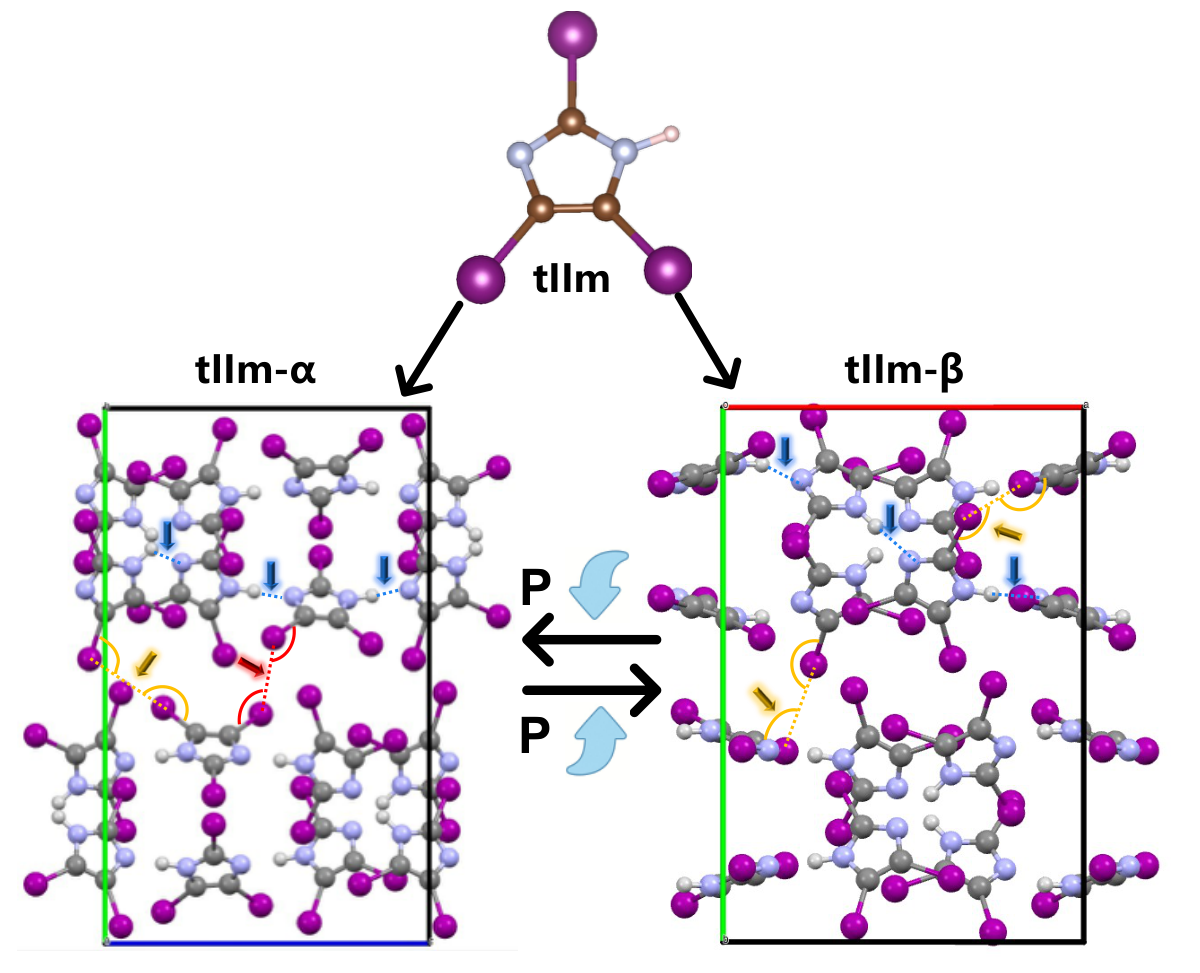
Efficient fine-tuning of foundation atomistic models for reversible polymorphic phase transitions in organic molecular crystals
Foundation atomistic models—pretrained, general-purpose machine-learned interatomic
potentials—offer a promising path toward universal, data-efficient atomistic simulation across
chemistry and materials science. However, their ability to capture rare, collective phenomena
in complex molecular systems remains largely untested. Here, we systematically evaluate the
transferability and fine-tuning of four state-of-the-art foundation atomistic models
(MACE-MP-0b, MACE-OFF-small, SevenNet, and CHGNet) for simulating the reversible α ⇌ β
polymorphic phase transition in the prototypical organic molecular crystal
2,4,5-triiodo-1H-imidazole (tIIm). Out-of-the-box, none of the models can reproduce the
complete reversible transition, reflecting their limitations in capturing subtle and finely
balanced non-covalent interactions outside their pretraining domain. By contrast, targeted
fine-tuning—especially using our recently developed parameter-efficient equivariant low-rank
adaptation (ELoRA) method—enables robust simulation of both transition directions and recovers
the full collective dynamics of the phase change. Mechanistic analysis reveals a stepwise
transition pathway with pronounced asymmetry in energy barriers, consistent with experimental
observations. Our results establish practical guidelines for adapting foundation atomistic
models to challenging materials phenomena and demonstrate that efficient fine-tuning protocols
are essential for realizing the promise of universal, transferable machine-learned interatomic
potentials in molecular materials simulation.
High-Performance Computing
Flux: Online, Fine-Grained Data Scheduling for Training Machine Learning Interatomic Potentials
Large-scale training of machine learning interatomic potentials (MLIPs) increasingly relies on
data parallelism over heterogeneous atomistic data. In this setting, atom count captures an
important part of the per-rank workload, but structures with similar atom counts can still
induce different graph workloads through variations in graph count, cutoff edges, higher-order
geometric features, and graph-collation overhead. This makes conventional atom-count batching
and offline load tables both incomplete and inflexible, especially when the model
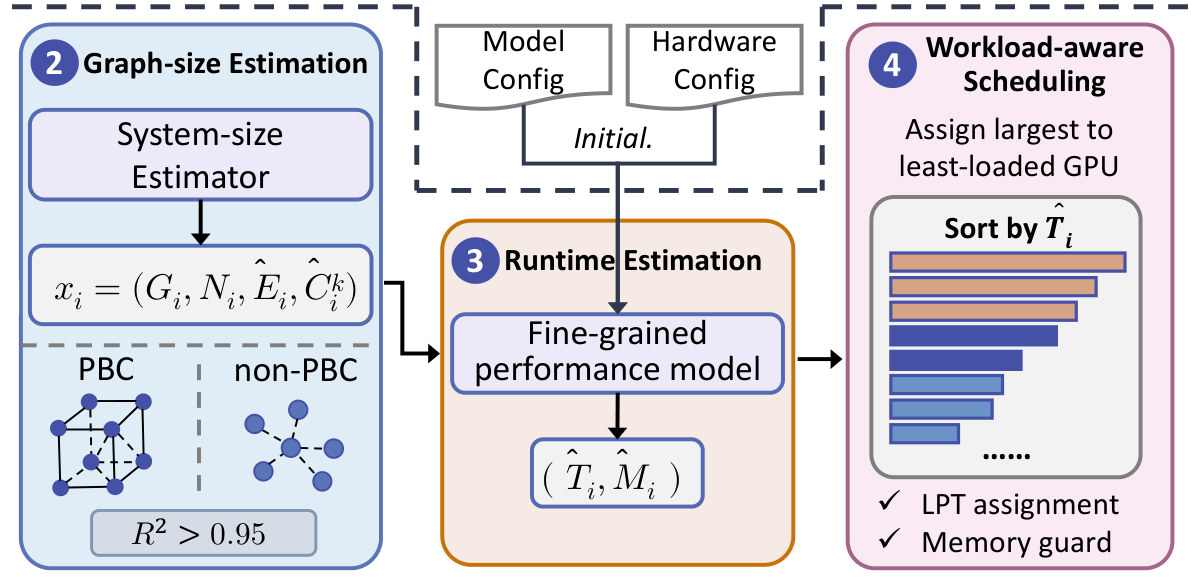
architecture, cutoff radius, or data mixture changes. We present Flux, an online
workload-aware scheduler for distributed MLIP training. Flux estimates graph-size features
from lightweight physical and geometric priors during data loading. It uses calibrated runtime
and memory models to form balanced local mini-batches across data-parallel ranks while
respecting memory constraints. Without requiring precomputed graph metadata, Flux can be used
as a drop-in replacement for the standard distributed sampler, making it flexible and portable
across training setups. Across large-scale atomistic datasets and three representative MLIP
architectures, eSEN, MatRIS, and AllScAIP, Flux improves training throughput by 2.23–4.76×
without degrading convergence.
MatterScale: Scaling Foundation Machine Learning Interatomic Potentials for Billion-Atom Molecular Dynamics on the Next-Generation Supercomputer
Machine learning interatomic potentials have enabled molecular dynamics with ab initio
accuracy at greatly reduced cost and at large scale. The field is now shifting toward
foundation machine learning interatomic potentials with broader transferability, but these
models are harder to scale because message-passing layers complicate distributed communication
and two-body and three-body features increase graph-construction cost and memory footprint. We
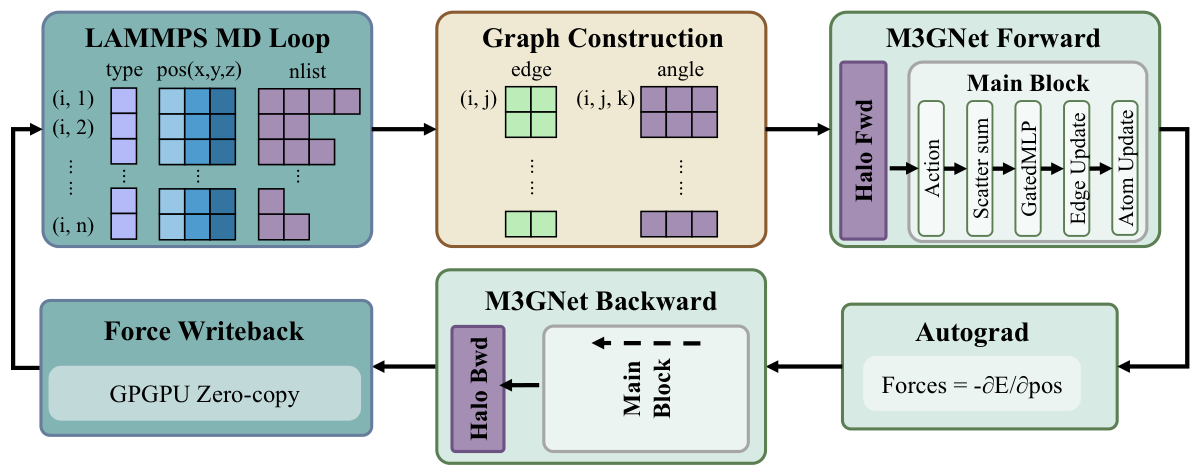
present MatterScale, an end-to-end framework for deploying foundation MLIPs on massively
parallel molecular dynamics workloads on a next-generation supercomputer. MatterScale combines
a Halo operator for nearest-neighbor inter-layer feature exchange, an ML-based
multiple-time-step scheme for higher throughput, layer-wise activation checkpointing for
higher per-node capacity, and a parallel graph-construction algorithm. With MatterSim,
MatterScale scales to 32,768 GPGPUs with 94% weak scaling efficiency and simulates up to 1.13
billion atoms.
FastCHGNet: Training One Universal Interatomic Potential to 1.5 Hours with 32 GPUs
Graph neural network universal interatomic potentials (GNN-UIPs) have demonstrated remarkable
generalization and transfer capabilities in material discovery and property prediction. These
models can accelerate molecular dynamics (MD) simulation by several orders of magnitude while
maintaining ab initio accuracy, making them a promising new paradigm in material simulations.
One notable example is Crystal Hamiltonian Graph Neural Network (CHGNet), pretrained on the
energies, forces, stresses, and magnetic moments from the MPtrj dataset, representing a
state-of-the-art GNN-UIP model for charge-informed MD simulations. However, training the
CHGNet model is time-consuming(8.3 days on one A100 GPU) for three reasons: (i) requiring
multi-layer propagation to reach more distant atom information, (ii) requiring second-order
derivatives calculation to finish weights updating and (iii) the implementation of reference
CHGNet does not fully leverage the computational capabilities. This paper introduces
FastCHGNet, an optimized CHGNet, with three contributions: Firstly, we design innovative
Force/Stress Readout modules to decompose Force/Stress prediction. Secondly, we adopt massive
optimizations such as kernel fusion, redundancy bypass, etc, to exploit GPU computation power
sufficiently. Finally, we extend CHGNet to support multiple GPUs and propose a load-balancing
technique to enhance GPU utilization. Numerical results show that FastCHGNet reduces memory
footprint by a factor of 3.59. The final training time of FastCHGNet can be decreased to 1.53
hours on 32 GPUs without sacrificing model accuracy.
TrimSO(2): Fast and Memory-Efficient Training of Equivariant Interatomic Potentials
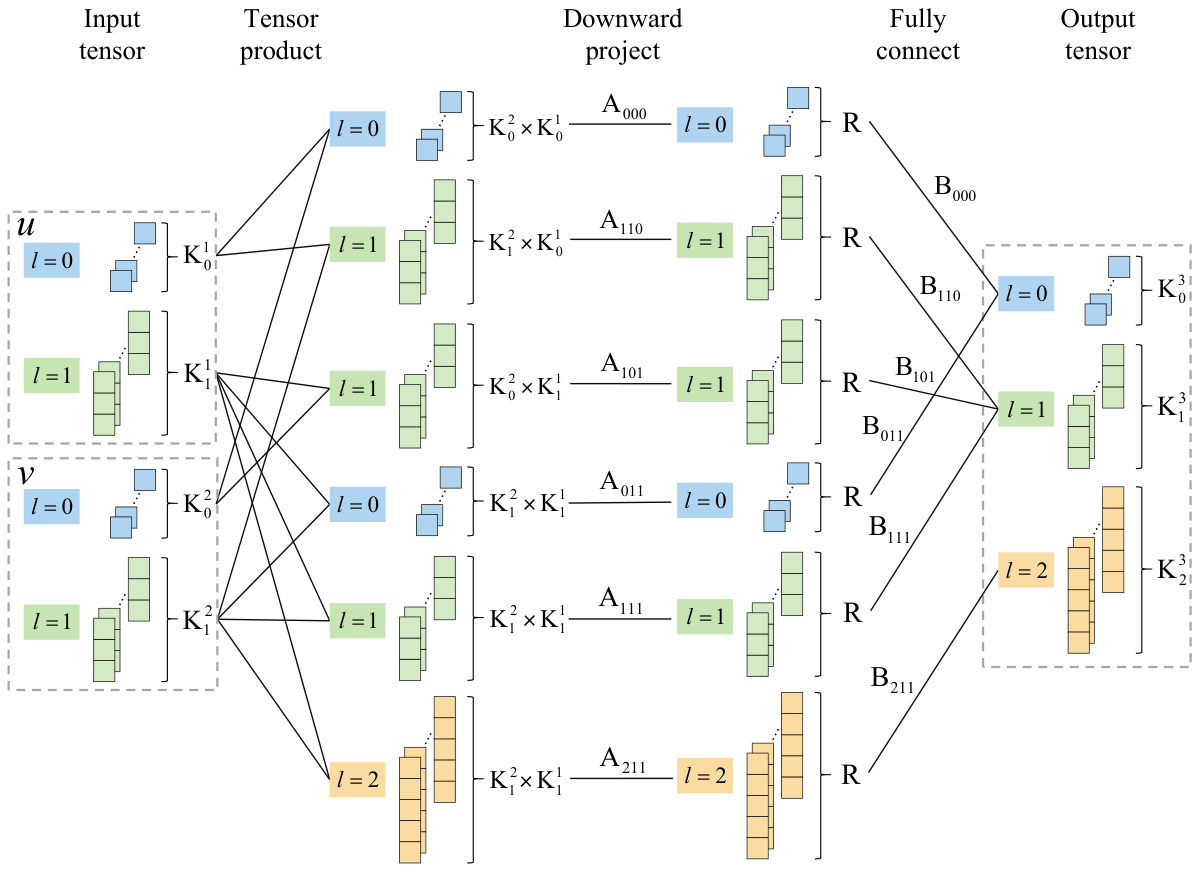
Equivariant interatomic potentials enable accurate and efficient simulations of molecules and
materials. Among them, models based on SO(2) convolutions reduce the cost of tensor products
and achieve state-of-the-art accuracy, but their training remains time-consuming and
memory-intensive. Existing training implementations materialize large edge tensors for
representation transformations surrounding dense matrix multiplications, increasing memory
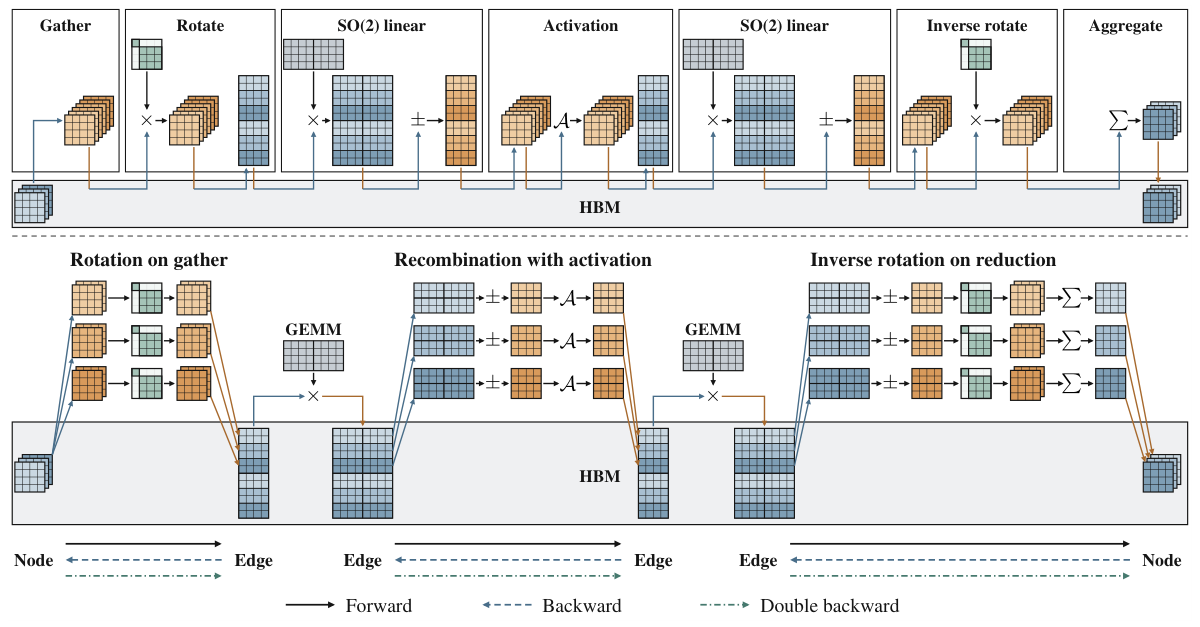
usage and data movement. We observe that these transformations can be integrated into the
model’s existing dataflow, avoiding separate intermediate materialization. We introduce
TrimSO(2), a fast and memory-efficient algorithm for SO(2)-based equivariant models. It
realizes this principle through rotation on gather, recombination with activation, and inverse
rotation on reduction, with support for the higher-order differentiation required for
training. By avoiding intermediate materialization, TrimSO(2) delivers 2.71–16.73× operator
speedups across forward, backward, and double backward and reduces model-level high-bandwidth
memory traffic by 3.81–9.88×. Finally, TrimSO(2) achieves 2.07–2.94× training speedups and
1.53–3.16× reductions in peak training memory over PyTorch implementations for official eSEN,
UMA, and EquiformerV3 workloads on A100 and H100 GPUs.
Accelerating Diffusion-Based Crystal Generation through Efficient Speculative Sampling
Crystal diffusion models offer a promising approach to generating structures for new
materials, but long sequences of serial denoising steps incur high generation latency and
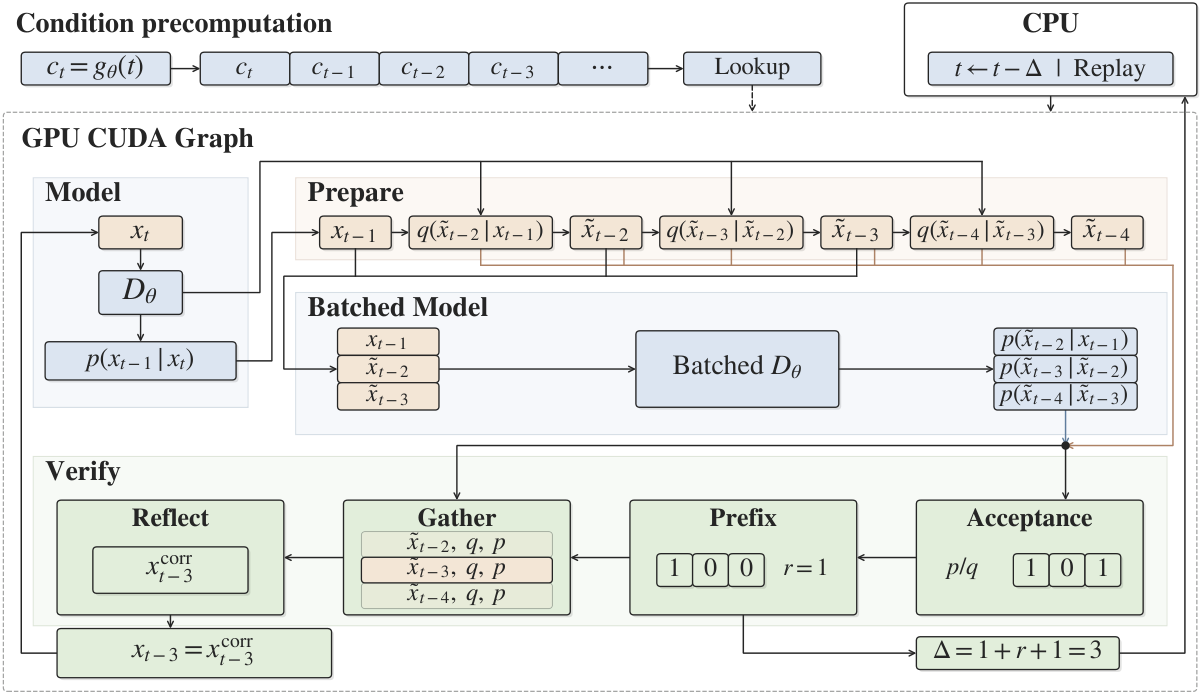
limit rapid iteration in materials design. This paper presents a speculative sampling method
for crystal diffusion that constructs candidates using frozen predictions and verifies them in
parallel, enabling multiple denoising steps to advance in a single verification round.
However, implementing this scheme directly requires the CPU and GPU to coordinate frequently
when preparing and verifying proposals, and each batched model call performs more work. To
reduce these costs, we combine whole-window CUDA Graph execution for lower CPU–GPU
coordination overhead with condition precomputation and model compilation for faster model
execution. Experiments on A100, RTX 3090 and H100 GPUs show that our method accelerates
CrystalDiT sampling by 10.61–13.27× over the official sequential sampler while maintaining
comparable generation quality.
LunaTP: Enabling Efficient and Scalable Tensor Product for Equivariant MLIPs
Equivariant machine learning interatomic potentials (MLIPs) promise atomistic simulations with
accuracy approaching that of quantum-mechanical calculations. However, the high computational
cost of their core Clebsch–Gordan tensor product (CGTP) convolutions severely limits model
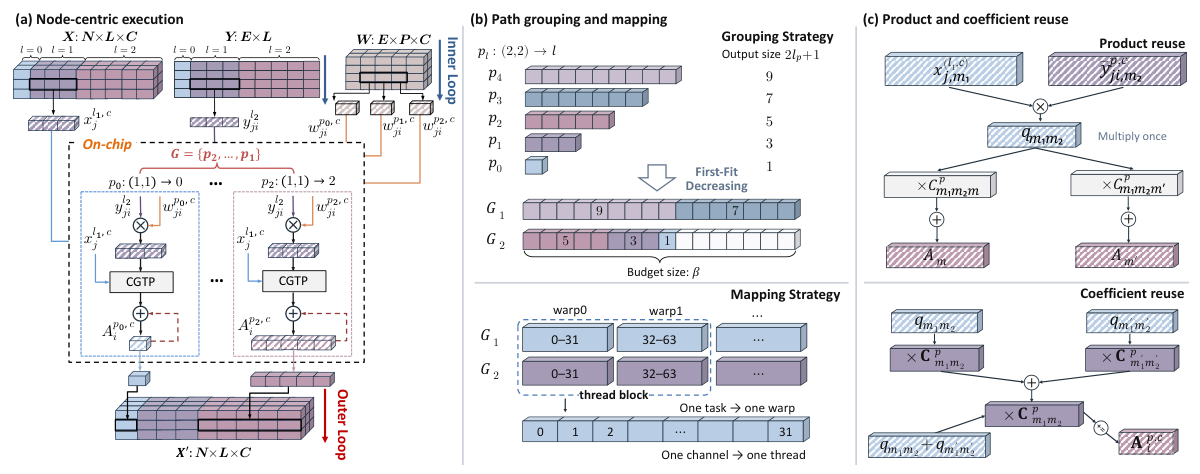
scalability and efficiency. In this paper, we rethink the parallel execution of CGTP
convolutions and introduce LunaTP. Built on node-centric execution, LunaTP exploits path-group
parallelism and multi-level reuse to accelerate CGTP convolutions and higher-order derivative
computation while preserving the underlying mathematical formulation. On an NVIDIA H100 GPU,
LunaTP achieves kernel speedups of up to 250.0× over e3nn and 17.1× over OpenEquivariance. It
also delivers end-to-end training throughput gains of up to 28.7× over e3nn and 3.11× over
OpenEquivariance. Finally, LunaTP demonstrates scalability and robust performance across
models, workload scales, and GPUs, delivering substantial acceleration for training and
atomistic simulation with high-accuracy equivariant MLIPs.
Breaking the Training Barrier of Billion-Parameter Universal Machine Learning Interatomic Potentials
Universal Machine Learning Interatomic Potentials (uMLIPs), pre-trained on massively diverse
datasets encompassing inorganic materials and organic molecules across the entire periodic
table, serve as foundational models for quantum-accurate physical simulations. However, uMLIP
training requires second-order derivatives, which lack corresponding parallel training
frameworks; moreover, scaling to the billion-parameter regime causes explosive growth in
computation and communication overhead, making its training a tremendous challenge. We
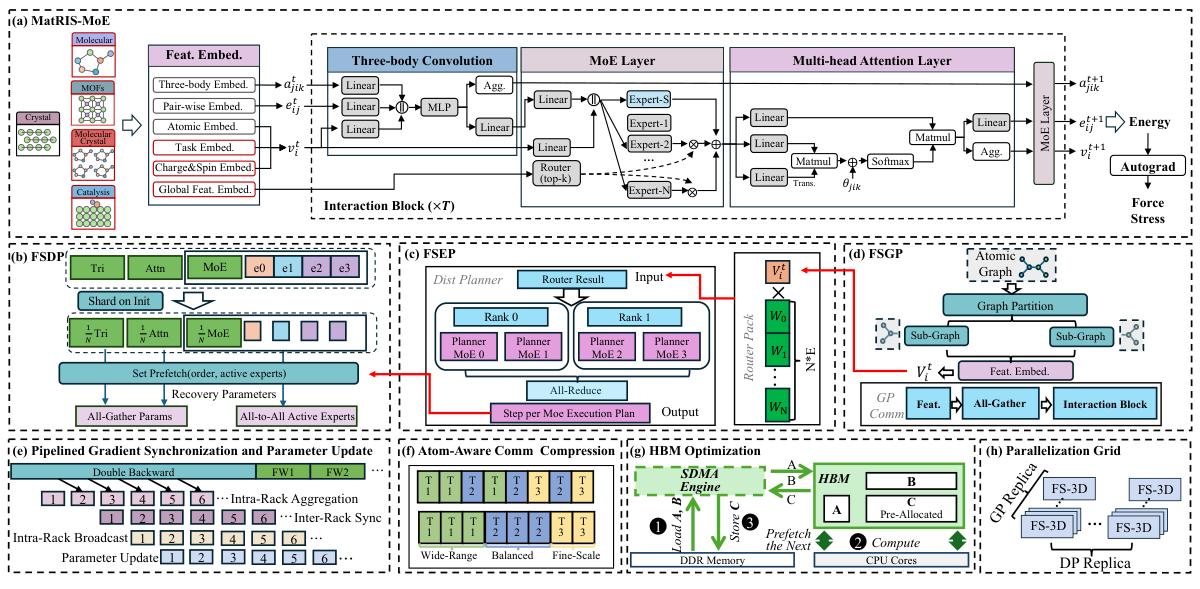
introduce MatRIS-MoE, a billion-parameter Mixture-of-Experts model built upon invariant
architecture, and Janus, a pioneering high-dimensional distributed training framework for
uMLIPs with hardware-aware optimizations. Deployed across two Exascale supercomputers, our
code attains a peak performance of 1.2/1.0 EFLOPS (24%/35.5% of theoretical peak) in single
precision at over 90% parallel efficiency, compressing the training of billion-parameter
uMLIPs from weeks to hours. This work establishes a new high-water mark for AI-for-Science
(AI4S) foundation models at Exascale and provides essential infrastructure for rapid
scientific discovery.
Awards
Academic Competitions
Chinese Mathematics Competitions for College Students